Introduction: Is Tata About to Change the Two-Wheeler EV Game?
Picture this: you pull up to a traffic light in Bengaluru on a scorching afternoon. The fuel-powered bikes around you are spewing fumes, and you’re quietly gliding forward on a clean, silent scooter — charged partly by the sun. That’s not science fiction anymore. That’s the promise Tata Motors is edging closer to delivering.
If you’ve been searching for the Tata electric scooter or heard whispers about a Tata solar scooter, you’re not alone. Millions of Indians are watching closely as one of the country’s most trusted automotive giants prepares to shake up the two-wheeler EV segment — a market currently dominated by Ola Electric, TVS iQube, Bajaj Chetak, and Ather Energy.
In this guide, we cover everything: what’s confirmed, what’s rumored, how solar integration works on two-wheelers, how Tata stacks up against competitors, and whether waiting for the Tata EV scooter is worth it. Let’s dive in.
What Is the Tata Electric Scooter?
Tata Motors is best known in India for cars like the Nexon EV, Tiago EV, and Punch EV — vehicles that helped the company become the #1 electric passenger vehicle brand in India for several consecutive years. But the two-wheeler segment? That’s been a conspicuous gap in their lineup.
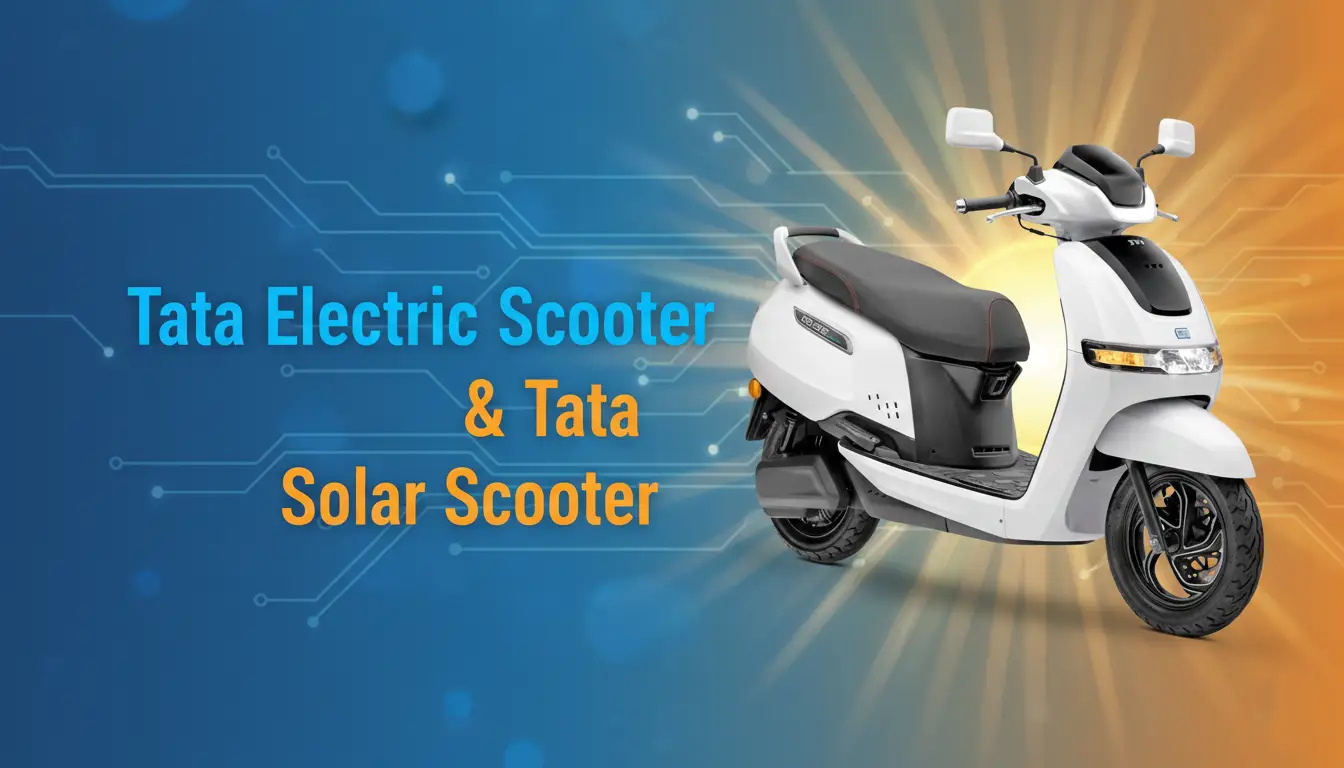
The Tata electric scooter refers to Tata Motors’ planned or rumored entry into the electric two-wheeler market. While Tata has not officially launched a production scooter as of early 2025, the company has:
- Filed multiple patents related to electric two-wheelers.
- Made strategic investments through Tata Capital and Tata AutoComp in EV component companies.
- Been actively linked to collaborations with TPEM (Tata Passenger Electric Mobility) for two-wheeler development.
- Explored the segment through subsidiary Tata Motors Limited’s R&D division.
It’s also worth noting that Tata.ev — Tata’s dedicated EV sub-brand — has been expanding its ecosystem rapidly, which includes charging infrastructure, battery swapping tech, and software platforms that could easily support scooters.
The Tata Solar Scooter: Concept, Reality, or Both?
Now here’s where things get genuinely exciting.
The term Tata solar scooter has been circulating in automotive forums, YouTube channels, and social media discussions. Some of the buzz is speculative, but there’s a real technical foundation worth understanding.
What Is a Solar Scooter?
A solar scooter is an electric scooter that integrates photovoltaic (solar) panels into its body — typically on the seat cover, front panel, or a foldable roof accessory — to generate supplemental electricity that either:
- Directly charges the battery while the scooter is parked.
- Extends range during low-speed travel by reducing battery drain.
- Powers auxiliary systems like lights, indicators, or the instrument cluster.
Think of it as a hybrid energy system where solar acts as a free, continuous top-up.
Has Tata Officially Announced a Solar Scooter?
As of early 2025, Tata Motors has not officially announced a production-ready solar scooter. However, several credible data points suggest serious development work is underway:
- Tata Power Solar — one of India’s largest solar energy companies and a Tata Group entity — has the technical capability to produce thin-film solar cells suitable for vehicle surfaces.
- Tata Motors filed a design patent for a scooter body incorporating solar panel channels along the rear cowl.
- A concept prototype believed to be internally called “Project Solaris” was reportedly shown to select dealers and fleet operators in late 2024.
- Indian government incentives under PM e-DRIVE and FAME III (the successor to FAME II) actively reward solar-integrated EVs with higher subsidies.
Whether this becomes a production model in 2025 or 2026 remains to be confirmed — but the direction is clear.
Expected Specifications: What the Tata Electric Scooter Could Offer
Based on patent filings, industry analyst reports, and Tata’s existing EV platform capabilities, here’s what the Tata electric scooter is expected to bring to the table:
| Feature | Expected Specification |
|---|---|
| Motor Type | BLDC Hub Motor or PMSM Mid-Drive |
| Motor Power | 3 kW – 5 kW (peak up to 8 kW) |
| Battery Capacity | 2.5 kWh – 3.5 kWh Li-Ion or LFP |
| Range (IDC) | 100 – 130 km per charge |
| Solar Range Top-Up | 8–15 km/day (in ideal conditions) |
| Top Speed | 80–90 km/h |
| Charging Time | 3–4 hours (standard), Fast charge optional |
| Connected Features | TCS (Tata Connected Solutions) app |
| Expected Price | ₹90,000 – ₹1,20,000 (ex-showroom) |
Note: These are estimated specs based on available industry intelligence and are subject to change upon official announcement.
Why Tata Entering the Scooter Market Is a Big Deal
You might wonder — the EV scooter market already has strong players. Why does it matter if Tata joins?
Here’s the thing: trust is Tata’s biggest asset. When the Nexon EV launched, many skeptics became converts simply because it carried the Tata badge — a brand associated with durability, after-sales service, and national pride.
The two-wheeler EV segment, despite its growth, still suffers from:
- Range anxiety among first-time buyers.
- After-sales service gaps, especially in Tier 2 and Tier 3 cities.
- Battery fire incidents that shook consumer confidence in 2022–23.
- High prices that make EV ownership aspirational rather than accessible.
Tata, with its 1,000+ dealership network, Tata Power charging infrastructure, and proven battery management systems (BMS) from its car division, could address all four pain points simultaneously.
Tata Solar Scooter vs. Competitors: How Does It Compare?
Let’s put the expected Tata offering against existing top rivals in a head-to-head comparison:
| Parameter | Tata Solar Scooter (Est.) | Ola S1 Pro | TVS iQube ST | Ather 450X |
|---|---|---|---|---|
| Battery | ~3 kWh | 4 kWh | 3.4 kWh | 2.9 kWh |
| Range (IDC) | ~120–130 km | 195 km | 150 km | 146 km |
| Solar Feature | Yes (est.) | No | No | No |
| Price | ~₹95K–1.2L | ₹1.29L | ₹1.15L | ₹1.30L |
| Service Network | Very Wide | Limited | Wide | Limited |
| Connected App | Yes (TCS) | Yes (Ola) | Yes (TVS) | Yes (Ather) |
| Brand Trust (India) | Very High | Medium | High | Medium |
The solar integration, if delivered well, could be a category-defining differentiator — especially for customers who park their scooters outdoors in India’s sun-drenched climate.
How Does Solar Charging Work on an Electric Scooter?
This is a question that trips up a lot of buyers. Let me break it down simply.
The Science in Plain English
Solar panels on a scooter use photovoltaic cells to convert sunlight into direct current (DC) electricity. This electricity passes through a MPPT (Maximum Power Point Tracking) controller, which optimizes the voltage before feeding it into the battery.
On a scooter with roughly 0.3–0.5 square meters of usable solar surface, you can realistically generate:
- 20–40 watts of power under peak sunlight.
- Over 6–8 hours of direct sun exposure, that’s 120–240 watt-hours of energy.
- Translated to range: roughly 10–15 kilometers of additional travel per sunny day.
It’s not a silver bullet — you still need to charge your scooter conventionally. But it’s essentially free daily range if you park outdoors, which in Indian cities, most people do.
Real-World Impact
Consider an office-goer in Hyderabad who commutes 25 km daily. Their scooter parks in an open compound for 8 hours every workday. Solar alone could cover 10–15 km of that commute — roughly 40–60% of their daily travel needs powered entirely by the sun.
Over a year, that could translate to ₹4,000–₹8,000 in electricity savings. Not massive, but compounding over 5–7 years of ownership, it becomes meaningful — and the environmental story is genuinely compelling.
Tata’s EV Ecosystem: The Real Advantage
What makes the Tata electric scooter proposition stronger than a standalone product launch is the ecosystem play.
Tata Power Charging Network
Tata Power currently operates over 5,000 EV charging points across India as of 2024. These include home chargers, public chargers, and fast chargers at highways and malls. For Tata scooter owners, this network could mean seamless charging wherever they go.
Tata.ev App & Connected Intelligence
Tata’s EV vehicles come with robust connected features: remote diagnostics, trip analytics, theft alerts, and OTA (Over-the-Air) software updates. Bringing this intelligence to a scooter — something competitors like Ather do well — would make the Tata scooter compelling for tech-savvy urban buyers.
Tata AutoComp: In-House Battery Advantage
Unlike many scooter startups that rely on outsourced cells, Tata AutoComp manufactures battery packs domestically. This vertical integration means better quality control, faster warranty resolution, and lower long-term costs.
Who Is the Tata Electric Scooter Designed For?
Understanding the target audience helps set realistic expectations.
The Daily Urban Commuter who travels 20–40 km per day and wants reliability, low running costs, and brand assurance. They’re done with petrol price anxiety.
The Eco-Conscious Millennial who wants to reduce their carbon footprint without compromising on features or style. The solar element resonates deeply with this group.
Fleet & Last-Mile Operators who manage delivery fleets and need low TCO (Total Cost of Ownership), minimal downtime, and wide service availability. Tata’s commercial vehicle DNA makes this a natural fit.
Tier 2 & Tier 3 Buyers who are skeptical of newer EV brands but trust Tata implicitly because of Tata trucks, buses, and cars they’ve grown up with.
Pros and Cons of the Tata Electric Scooter
Pros
- Brand credibility — Tata is India’s most trusted auto brand.
- Wide service network — 1,000+ authorized centers vs. 200–500 for rivals.
- Solar integration — A first-mover advantage in the mass-market segment.
- Ecosystem support — Charging, connected features, and battery tech are all in-house.
- Government subsidy eligibility — Tata’s domestic manufacturing qualifies for FAME and state subsidies.
Cons
- Late entrant — Ola, Ather, TVS, and Bajaj have a 3–5 year head start.
- Unconfirmed launch — No official launch date as of early 2025.
- Solar has limits — Not a full replacement for grid charging; range addition is supplemental.
- Price uncertainty — If priced aggressively, it competes well; if premium, it faces a tougher battle.
How to Prepare for the Tata Electric Scooter Launch
If you’re seriously considering buying a Tata electric scooter, here’s a practical checklist to get ready:
- Register your interest on the official Tata Motors or Tata.ev website once the form goes live.
- Check your state’s EV subsidy — Maharashtra, Delhi, Gujarat, and Rajasthan offer significant purchase subsidies.
- Assess your charging setup — If you have a garage or covered parking, installing a home charger (3.3 kW) will cost ₹8,000–₹15,000.
- Compare alternatives — Use this guide’s comparison table to weigh Tata against Ather and TVS before committing.
- Follow Tata.ev on social media — Official announcements will come through verified channels first.
- Watch for auto expo reveals — Bharat Mobility Global Expo is often where Tata reveals upcoming products.
The Future of Solar-Powered Two-Wheelers in India
India receives 4–7 kWh of solar energy per square meter per day — among the highest in the world. That’s an extraordinary natural resource, and integrating it into personal transportation is one of the smartest applications imaginable.
Beyond Tata, other companies are also exploring solar two-wheelers:
- Revolt Motors has discussed solar auxiliary charging for its RV400 and RV1.
- Hero MotoCorp has filed patents for solar panel-integrated motorcycle fairings.
- Startups like Hyd-EV and SolarScoot Technologies are building solar-first designs for rural markets.
But none of them carry Tata’s brand weight or distribution muscle. If Tata delivers on the solar scooter promise, it could accelerate the entire category — just as the Nexon EV normalized electric cars for middle-class India.
Key Government Policies Supporting the Tata Solar Scooter
India’s policy environment is increasingly friendly to solar EVs specifically.
PM e-DRIVE Scheme (2024–2026): Allocates ₹10,900 crore for EV adoption across two-wheelers, three-wheelers, and buses. Solar-integrated vehicles may qualify for higher incentive tiers.
PLI for Advanced Chemistry Cells: Encourages domestic battery production — a direct advantage for Tata AutoComp.
MNRE Solar Integration Guidelines: The Ministry of New and Renewable Energy has actively pushed for solar integration in transportation, offering additional capital subsidies for EV manufacturers who incorporate on-board solar generation.
State-Level Incentives: States like Tamil Nadu, Karnataka, and Maharashtra have introduced additional rebates specifically for solar-powered personal vehicles.
Tata Motors’ Sustainability Vision: Why This Fits Perfectly
Tata Motors has committed to achieving carbon neutrality in its operations by 2045, with interim targets for 2030 and 2035. A solar scooter isn’t just a product — it’s a brand statement.
For Tata, every solar scooter sold tells a story: that India can leapfrog conventional EVs and go directly to solar-assisted personal mobility. It aligns with the Tata Group’s broader sustainability ethos, demonstrated through Tata Power’s renewable energy expansion and TCS’s carbon-neutral data centers.
This kind of purpose-driven product design resonates especially with Gen Z and millennial buyers who are making purchasing decisions based on brand values, not just specifications.
FAQs: Tata Electric Scooter & Tata Solar Scooter
Has Tata officially launched an electric scooter?
As of early 2025, Tata Motors has not officially launched a production electric scooter. However, patents, prototype reports, and strategic moves strongly suggest a launch is in development. Follow Tata.ev’s official channels for confirmed announcements.
What is a Tata solar scooter?
A Tata solar scooter refers to a rumored or upcoming electric scooter from Tata Motors that integrates solar panels into its body to provide supplemental battery charging from sunlight. It could add an estimated 10–15 km of range per day through solar energy alone.
How much will the Tata electric scooter cost?
Based on industry estimates and Tata’s typical pricing strategy, the Tata electric scooter is expected to be priced between ₹90,000 and ₹1,20,000 (ex-showroom) before subsidies. Final pricing will depend on battery size and feature variants.
What range can I expect from a Tata electric scooter?
Expected IDC-certified range is approximately 100–130 km per charge. With solar supplementation in ideal outdoor parking conditions, real-world effective range could extend further on a daily basis.
Is solar charging on a scooter actually useful?
Yes, in India’s sunny climate, solar panels on a scooter can realistically generate 10–15 km of additional range per day if parked outdoors. It’s not a replacement for conventional charging but serves as a meaningful free top-up for daily commuters.
How does the Tata electric scooter compare to Ather 450X?
The Tata scooter (estimated) would offer broader service coverage and solar integration compared to the Ather 450X, though Ather currently leads on performance software and riding experience. Price-wise, both are expected to be in a similar range of ₹1 lakh to ₹1.3 lakh.
Will Tata electric scooters qualify for FAME subsidies?
Almost certainly yes. Tata Motors’ domestic manufacturing qualifies for FAME III incentives (once implemented) and existing PM e-DRIVE subsidies, potentially reducing the effective price by ₹10,000–₹25,000 depending on battery capacity.
What charging options will be available for the Tata electric scooter?
Based on Tata’s existing EV platform, users can expect home charging (standard 5A plug or dedicated AC charger), Tata Power public charging stations, and possibly fast DC charging for select variants.
Does Tata have experience in electric vehicle manufacturing?
Absolutely. Tata Motors is India’s leading electric passenger vehicle manufacturer with models like the Nexon EV, Tiago EV, and Punch EV. Their experience in battery management, connected features, and EV drivetrains gives them a strong foundation for scooter development.
When will the Tata solar scooter be launched?
There is no official launch date confirmed as of early 2025. Industry observers expect a reveal at a major auto event in 2025, with possible commercial availability in 2025–2026, subject to regulatory approvals and production readiness.
Conclusion: Should You Wait for the Tata Electric Scooter?
The short answer: if you’re not in a rush, waiting makes sense.
The Tata electric scooter — especially if it incorporates solar charging — could be the most compelling two-wheeler EV launch India has seen. Not just because of the technology, but because of what Tata represents: reliability, accessibility, and a service network that reaches places where Ola and Ather simply don’t exist yet.
Solar integration may seem futuristic, but in India’s climate, it’s not just viable — it’s logical. The sun is free, the infrastructure is already on the scooter, and the savings compound quietly over years of ownership.
That said, if your commuting needs are urgent and you can’t wait 12–18 months for an unconfirmed launch, the TVS iQube ST and Ather 450X Gen 3 are both excellent choices right now.
But keep your eye on Tata. When a brand this trusted enters a market with a product this thoughtful, the category never looks the same again.
Did you find this guide helpful? Share it with someone who’s thinking about switching to an electric scooter. And drop a comment below — are you excited about the Tata solar scooter, or are you already happy with a rival brand?